
Politics is no longer recognized through institutions, but through leisure — the entrance to democracy has moved
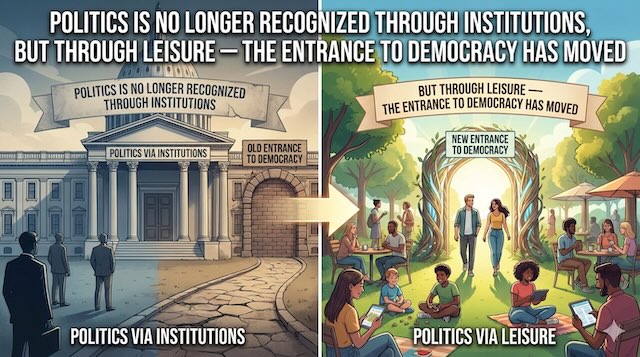
Politics has traditionally been understood as an institutional process: policies, elections, political parties, and parliamentary procedures. In practice, however, political judgment is increasingly formed within leisure. Leisure here does not mean entertainment, but the allocation of attention and time.
Today, the entrance to politics is not institutions but algorithms. Videos, SNS feeds, recommended news, search rankings, and platform timelines have become the environment in which political recognition is formed. One can make political judgments without accessing institutions or policies, but judgments that bypass institutions inevitably weaken institutional politics. This shift is quiet but constitutes a significant structural change for democracy.
This phenomenon is most visible among what might be called the “non-aligned voter segment”. This segment is not avoiding institutions; rather, it recognizes politics outside them. Institutions require effort, time, and explanation. Algorithms require none of these. For most people, leisure is a more efficient medium for forming political judgments than institutional politics.
Several observations clarify this shift:
• Do we access institutions when thinking about politics?
• Do SNS and video influence recognition more than policies?
• Are political judgments made without institutional understanding?
• Does leisure shape preferences more than elections?
• Have algorithms become the entrance to political cognition?
These are not opinions but observations. The entrance to politics now lies in leisure, not in institutions, and in algorithms rather than procedures.
Institutional politics requires time, negotiation, and explanation. Algorithms optimize for immediacy, preference, and frictionless consumption. Institutional politics depends on consensus; algorithms depend on selection. Over time, this asymmetry reshapes democratic functioning.
The point is not to criticize “leisure politics”. Human cognition naturally follows the path of lower effort. The issue is that democracy is not designed to operate when the entrance (recognition and judgment) lies outside institutions while the exit (voting and administration) lies within them. The middle layer — explanation, understanding, and consensus formation — has evaporated.
Institutions remain only at the exit. Leisure controls the entrance. The middle has disappeared. If left unaddressed, institutional politics will weaken while democracy remains intact as form but hollow as practice — absorbed into leisure optimization.
The spread of generative AI accelerates this dynamic. AI does not strengthen institutions or policies; it optimizes leisure. If leisure is the entrance to democracy, AI inevitably pulls democratic functioning toward the leisure side rather than the institutional side. This is not political decay so much as a silent migration of the democratic entrance.
To maintain democratic capacity, we must redesign the interface between institutions and leisure, rather than treat them as separate domains. Thinking seriously about one’s country increasingly requires not only understanding institutions as democratic exits, but also understanding leisure as its entrance.
政治の認知は制度ではなく余暇で行われている
──民主主義の入口が静かに移動している
政治は制度で処理され、選挙で決まり、政党が担うものと考えられてきました。しかし現実には、政治判断は制度の中ではなく、余暇の中で形成されています。余暇とは娯楽のことではなく、注意と時間をどこに割り当てるかという配分のことです。
いま政治の入口は、制度ではなくアルゴリズムになっています。動画、SNS、ニュースの推薦、検索結果、タイムラインの表示順位は、余暇の中で政治認知を行う装置となっています。制度を知らなくても政治判断はできますが、制度を経由しない判断は制度政治を弱くします。これは静かな構造変化です。
この現象は無党派層で最も鮮明に見られます。無党派は制度を避けているのではなく、制度の外で政治認知を行っています。制度は時間と手間を必要としますが、アルゴリズムはそれを必要としません。余暇の方が政治判断にとって効率がよいのです。
制度は出口(投票・行政)に残り、余暇は入口(認知・判断)を握り、中間の説明と合意形成は蒸発しています。AIはこの構造を加速させます。民主主義を維持するには、制度と余暇の接続を再設計することが必要です。
大原達朗が行うBBT大学での講座93%が満足と回答したファイナンスドリブンキャンプ
本講座では、短期間でCFO(最高財務責任者)への第1歩を踏み出すことを目指します。大量の決算書に触れ、大量にアウトプットし、大量のフィードバックを通してファイナンスという武器を手に入れられます。ブログでは話せない「ライブ講義」も充実しています。まずは無料説明会を受講してみて下さい。
本誌について
本誌は、M&Aを売り手、買い手、アドバイザーが三方良し、となるのが当たり前の世界の実現を目指しています。そのためには当事者が正しい情報を得て、安心して相談のできる場が必要です。その実現に向けて本誌は、日本M&Aアドバイザー協会で、以下のサービスやセミナーを提供しております。
| M&A仲介・アドバイザーを事業としたい方・既にされている方へ | |||
|---|---|---|---|
| セミナー・サービス名 | 詳細 | 金額 | 時間 |
| 誰にでもわかるM&A入門セミナー | ・会場開催の詳細とお申込み ・オンライン講座の視聴 |
無料 | 2時間 |
| M&A実務スキル養成講座 | ・会場開催の詳細とお申込み ・オンライン開催の詳細とお申込み ・M&A実務スキルの詳細 |
198,000円 | 2日間 |
| JMAA認定M&Aアドイザー資格取得およびJMAA会員に入会 | ・資格詳細とお申し込み | 入会金33,000円 月会費11,000円(1年分一括払) | - |
| 案件サポート制度 | JMAA会員が初めてM&Aアドバイザリー業務に取り組む場合、あるいはすでに何度かアドバイザリー業務に経験があっても、難易度が高い案件の場合のための、JMAA協会が会員に伴走して案件成約に向けて協力する制度です。 お申し込みは当協会ご入会後にお知らせします。 | JMAA正会員の関与する対象案件の成功報酬の50% | - |
| 買収を検討されている企業団体様へ | |||
| セミナー・サービス名 | 詳細 | 金額 | 時間 |
| 誰にでもわかるM&A入門セミナー | ・会場開催の詳細とお申込み ・オンライン講座の視聴 |
無料 | 2時間 |
| M&A実務スキル養成講座 | ・会場開催の詳細とお申込み ・オンライン開催の詳細とお申込み ・M&A実務スキルの詳細 |
198,000円 | 2日間 |
| 買い手様向けセカンドオピニオンサービス | ・M&Aセカンドオピニオンサービスの詳細 | 33,000円 追加相談サービス 33,000円/1時間 | 1時間〜 |
| 売却を検討されている企業団体様へ | |||
| セミナー・サービス名 | 詳細 | 金額 | 時間 |
| 誰にでもわかるM&A入門セミナー | ・会場開催の詳細とお申込み ・オンライン講座の視聴 |
無料 | 2時間 |
| M&A実務スキル養成講座 | ・会場開催の詳細とお申込み ・オンライン開催の詳細とお申込み ・M&A実務スキルの詳細 |
198,000円 | 2日間 |
| 売り手様向けセカンドオピニオンサービス | ・M&Aセカンドオピニオンサービスの詳細 | 33,000円 | 1時間〜 |

M&A実務を体系的に学びたい方は、M&A実務スキル養成講座

メルマガ登録はこちら
ファイナンスドリブンキャンプ
生成AIキャンプ

大原達朗の経営リテラシー-自ら考え、行動しよう-